
Discover how our frontend expertise can transform your web applications.
We analyze your requirements and create a component architecture that aligns with your business goals, ensuring scalability and maintainability.
Our team builds reusable Vue3 components using the composition API, TypeScript, and modern CSS approaches for consistent, high-quality interfaces.
We connect Vue3 frontends to your existing backend services through RESTful APIs, GraphQL, or WebSockets, ensuring secure and efficient data exchange.
Comprehensive testing across browsers and devices, with performance optimization for fast loading and responsive interactions even with large datasets.
We implement CI/CD pipelines for reliable deployment and provide ongoing support to keep your applications current with evolving best practices.

Data-rich interfaces that visualize complex information and allow users to explore insights through intuitive filtering and drill-down capabilities.

Unified access points for business applications that streamline workflows and improve productivity through consistent user experiences.

High-performance shopping experiences with real-time inventory updates, product filtering, and checkout processes.

Intuitive interfaces that empower customers to manage their accounts, access support, and complete transactions without direct assistance.

Custom applications that simplify complex administrative tasks and provide clear visibility into business operations.

ABAP programs facilitate complex data migration scenarios and implement specialized data management routines that maintain data quality and ensure business continuity during system transitions.
Contact us to discuss your frontend needs and explore our portfolio of Vue3 projects.
For a European chemical industry company, we implemented integration between 5 business units with 5 Salesforce instances, 3 SAP instances, and approximately 10 interfaces per business unit, including customer master data, orders, invoices, and deliveries. The project covered operations in Poland and Germany, with migration from SAP PO to SAP Integration Suite.
Client
Leading Retail Chain
Challenge
The client’s SAP PO platform couldn’t scale or support growth, hindering integrations with modern systems and rapid innovation.
Sulution
Introduction of SAP Integration Suite and migration of selected integrations to a new platform
Results
For a global manufacturing equipment provider, we created 30 interfaces connecting their Salesforce instance with SAP IS across EMEA, APAC, Americas, and Africa regions, using both API and event-based approaches for customer data, orders, and inventory management.
Client
Global Chemical Manufacturer
Challenge
A global manufacturer faced scaling issues with SAP PO after acquisitions, slowing A2A/B2B integration and operations.
Sulution
Results
Client
Industrial Equipment Manufacturer
Challenge
BizTalk’s outdated system blocked modernization, creating inefficiencies and adaptation challenges.
Sulution
Results
We prioritize intuitive, accessible interfaces that enhance user satisfaction while meeting business requirements and technical constraints.
Whether you’re looking for tailored migration solutions or just need more information, we’re here to support you every step of the way. Fill out the form below, and we’ll get back to you promptly.

Radosław Ruciński
SAP Integration Architect / co-owner
tel: +48 450 064 128
e-mail: radoslaw.rucinski@sygeon.com
Vue3 offers an excellent balance of performance, developer experience, and flexibility. Its progressive nature allows for incremental adoption in existing projects, while the composition API provides better code organization for large applications. For most projects, Vue3 delivers comparable performance to React with a gentler learning curve and more intuitive approach to reactivity.
Vue3 applications typically communicate with backend systems through RESTful APIs, GraphQL, or WebSockets. The framework is backend-agnostic, making it compatible with Python, Node.js, Java, .NET, and other server environments. We implement standard authentication methods (JWT, OAuth) and efficient data fetching patterns to ensure secure, responsive connections between frontend and backend.
Yes, Vue3 applications can be built with responsive design principles to work across desktop and mobile browsers. For more advanced mobile capabilities, Vue3 can be combined with frameworks like Ionic or wrapped in a native container like Capacitor to create hybrid mobile applications. Additionally, Vue3 can be used to build Progressive Web Apps (PWAs) that offer app-like experiences on mobile devices.
The Composition API is a major feature introduced in Vue3 that provides a more flexible way to organize component logic. Unlike the Options API (Vue2’s primary pattern), the Composition API enables better code reuse, more intuitive TypeScript integration, and clearer organization of complex component logic. This makes Vue3 applications more maintainable and scalable as they grow in complexity.
We implement several strategies to optimize Vue3 performance: component lazy-loading to reduce initial bundle size, virtual scrolling for large data sets, efficient state management using Pinia, carefully controlled component re-rendering, and server-side rendering or static site generation when appropriate. We also use performance monitoring tools to identify and address bottlenecks during development.
Yes, Vue3 can be incrementally adopted in existing applications. It can be added to a specific section of a traditional website, integrated into legacy frameworks, or used to gradually replace older frontend implementations. This flexibility is one of Vue’s core design principles and makes it particularly suitable for modernizing existing systems without complete rewrites.
We typically build Vue3 applications using the Vue CLI or Vite for modern, optimized tooling. For state management, we use Pinia (the official Vue recommendation). Other common tools in our stack include Vue Router for navigation, Vitest for unit testing, Playwright for end-to-end testing, and Storybook for component documentation. We also leverage TypeScript for type safety and improved developer experience.
Frontend development has evolved significantly in recent years, with developers increasingly seeking frameworks that balance performance, flexibility, and developer experience. Vue3 represents a significant advancement in this space, offering powerful capabilities without the steep learning curve associated with other popular frameworks.
At its core, Vue3 maintains the approachable nature that made earlier versions popular while introducing substantial improvements in performance and architecture. The framework’s virtual DOM implementation has been completely rewritten in Vue3, resulting in rendering that’s up to 2-3x faster than Vue2 and competitive with other leading frameworks like React.
What truly distinguishes Vue3 is its progressive adoption model. Unlike all-or-nothing frameworks, Vue can be introduced gradually into existing projects – from enhancing simple HTML pages with reactive components to building complex single-page applications. This flexibility makes it particularly valuable for organizations modernizing legacy systems or those seeking to standardize frontend development across diverse projects.
For enterprise applications where maintainability is crucial, Vue3’s Composition API provides significant advantages. This API offers a more intuitive way to organize and reuse code in complex components, replacing the sometimes confusing mixins pattern from Vue2. The result is cleaner, more maintainable code that scales with application complexity.

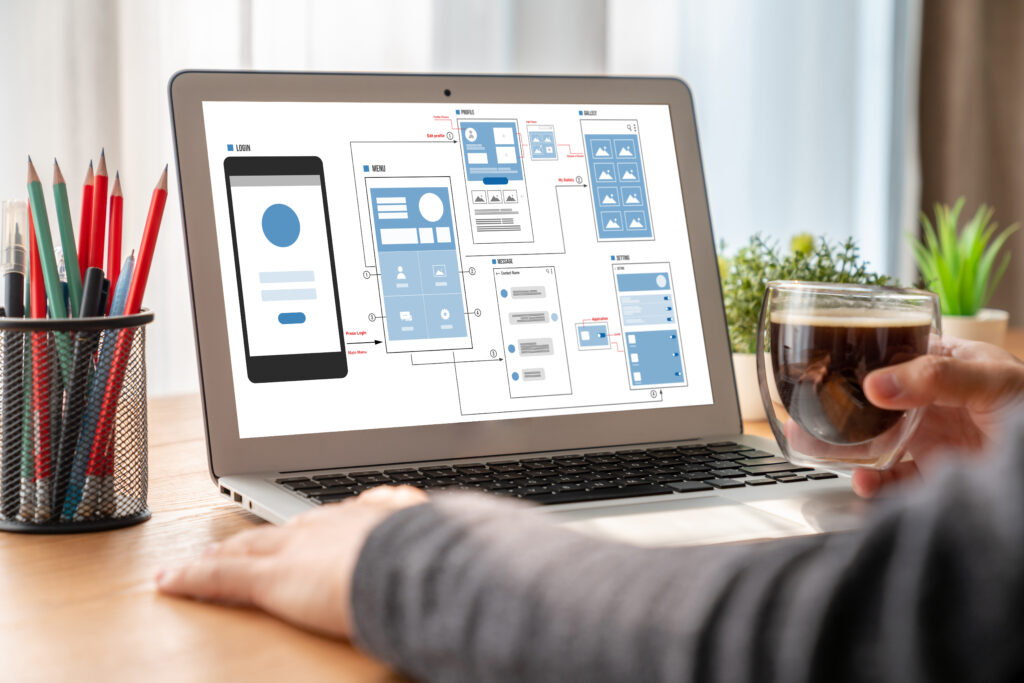
Modern web applications must deliver responsive, intuitive experiences across a wide range of devices and network conditions. Vue3 provides several key features that simplify the development of such interfaces while maintaining high performance.
The component-based architecture of Vue3 encourages developers to build applications from small, reusable pieces that can be combined to create complex interfaces. Each component encapsulates its own HTML, CSS, and JavaScript, promoting code reuse and clearer organization. This modular approach also facilitates collaborative development, as teams can work on different components simultaneously without conflicts.
Vue3’s reactivity system provides another significant advantage for responsive interfaces. Through a refined reactivity model based on JavaScript Proxies, Vue3 automatically tracks dependencies between data and the DOM, updating only the necessary components when data changes. This granular updating mechanism ensures efficient rendering even in data-intensive applications like dashboards or analytics tools.
For applications that must work across diverse devices, Vue3’s integration with CSS frameworks and preprocessors simplifies the implementation of responsive designs. Whether using utility-based approaches like Tailwind CSS or component libraries like Vuetify, developers can create interfaces that adapt to different screen sizes while maintaining a consistent codebase.
The framework’s small size – approximately 20KB gzipped for the core runtime – contributes to faster initial loading, particularly important for mobile users or those on slower connections. When combined with built-in support for code-splitting, Vue3 enables applications that load quickly and remain responsive throughout the user experience.
While Vue3 excels as a frontend framework, its true value emerges when effectively integrated with backend systems to create complete applications. The framework’s flexibility makes it compatible with virtually any backend technology, from traditional server-rendered applications to modern API-based architectures.
For organizations using Python backends, Vue3 provides an ideal frontend companion. The combination leverages Python’s strengths in data processing, machine learning, and server-side logic while using Vue3 to create responsive user interfaces. Communication typically occurs through RESTful APIs or GraphQL, with Vue3’s fetch or axios libraries handling HTTP requests. This separation of concerns allows each technology to excel in its domain while maintaining a clean architecture.
State management represents one of the most significant challenges in frontend-backend integration. Vue3 addresses this through official libraries like Pinia, which provides a centralized store for application state. This approach simplifies data synchronization between the frontend and backend while enabling features like caching responses and optimistic UI updates that improve perceived performance.
Authentication and security in Vue3 applications follow established patterns for single-page applications. JSON Web Tokens (JWT) have become the standard approach for maintaining user sessions, with tokens stored securely and included in API requests to the backend. Vue3’s router includes navigation guards that integrate with these authentication mechanisms to control access to protected routes based on user permissions.
For applications requiring real-time updates, Vue3 works with WebSocket connections or server-sent events. The framework’s reactive nature makes it particularly well-suited for displaying live data from backend systems, automatically updating the interface when new information arrives without requiring complex manual DOM manipulation.

tel: +48 450 064 128
e-mail: contact@sygeon.com
Globis Globe Trade Centre
Roosevelta 18
60-829 Poznań
NIP 7811909564