
Connect with trading partners faster while reducing errors and costs with modern EDI solutions.
Electronic Data Interchange (EDI) integration automates the exchange of standardized business documents between trading partners. This technology eliminates manual processes in B2B communications, enhancing speed, accuracy, and efficiency.
EDI works across various standards::
With its intuitive, web-based interface and prebuilt connectors for SAP and non-SAP systems, SAP Integration Suite simplifies complex integration challenges, enabling faster deployments and smoother data flows across your organization.
Enhanced Data Quality
Increased Security
Contact us to learn how SAP Integration Suite can improve your EDI landscape.
SAP Integration Suite provides a unified, web-based environment designed to simplify integration processes across your organization.
The system captures business events from your ERP or other applications and converts internal data formats into standardized EDI documents.
EDI documents are securely sent to trading partners using their preferred communication protocols (AS2, SFTP, API, etc.) with encryption and authentication.
A central repository maintains all partner profiles, communication preferences, and document specifications, simplifying relationship management.
Real-time visibility into document flows with alerts for exceptions allows teams to quickly address issues before they impact business operations.
Received EDI documents are validated, translated into internal formats, and integrated directly with your business applications to automate processes.
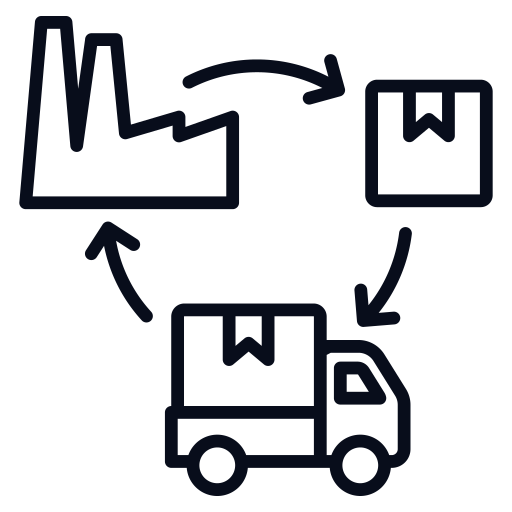
Automate the entire order-to-cash and procure-to-pay cycles with EDI-enabled purchase orders, shipping notices, invoices, and payment confirmations.

Major retailers often mandate specific EDI formats and timelines for suppliers. Modern EDI solutions help you meet these strict requirements, avoid costly chargebacks, and maintain preferred vendor status with key retail customers.
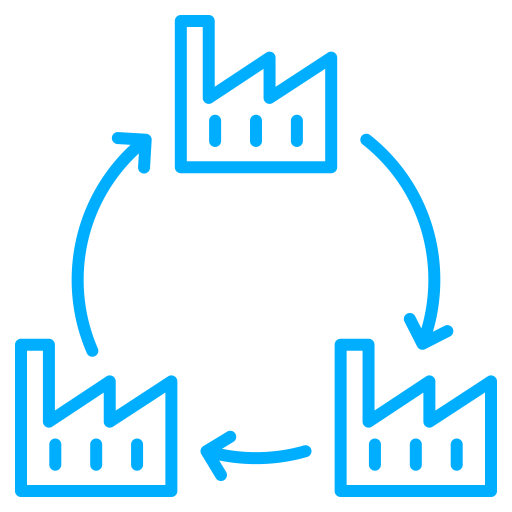
Coordinate production schedules and inventory management across your manufacturing network through automated EDI document exchange.

Improve transportation efficiency by automating shipping instructions, load tenders, status updates, and freight payment processes through EDI.

Enable just-in-time manufacturing by integrating production forecasts, material requirements planning, and delivery schedules between automotive OEMs and tiered suppliers through standardized EDI transactions.
Schedule a consultation with our EDI integration experts.
Client
Leading Retail Chain
Challenge
The client’s SAP PO platform couldn’t scale or support growth, hindering integrations with modern systems and rapid innovation.
Sulution
Introduction of SAP Integration Suite and migration of selected integrations to a new platform
Results
Client
Global Chemical Manufacturer
Challenge
A global manufacturer faced scaling issues with SAP PO after acquisitions, slowing A2A/B2B integration and operations.
Sulution
Results
Client
Industrial Equipment Manufacturer
Challenge
BizTalk’s outdated system blocked modernization, creating inefficiencies and adaptation challenges.
Sulution
Results
Whether you’re looking for tailored migration solutions or just need more information, we’re here to support you every step of the way. Fill out the form below, and we’ll get back to you promptly.

Radosław Ruciński
SAP Integration Architect / co-owner
tel: +48 450 064 128
e-mail: radoslaw.rucinski@sygeon.com
SAP Integration Suite supports key industry standards such as UN/EDIFACT, ANSI ASC X12, GS1 EDI, TRADACOMS, ODETTE, VDA. It also offers flexible adapters for file formats like XML, CSV, and custom flat files, ensuring compatibility with diverse systems and partners.
Integration Advisor uses machine learning to suggest and validate data mappings, reducing manual configuration and speeding up deployment.
TPM centralizes partner onboarding, communication protocol management, and monitoring, enhancing collaboration and reducing operational overhead.
EDI integration eliminates manual document processing, reduces errors, prevents compliance fines and chargebacks, accelerates order-to-cash cycles, and decreases inventory costs through improved visibility and forecastin.
Yes, SAP Integration Suite includes adapters and connectors that bridge modern cloud infrastructure with legacy EDI systems. This enables organizations to maintain existing EDI investments while gradually modernizing their integration landscape
SAP Integration Suite implements multiple security layers for EDI communications, including encryption during transmission, digital signatures, OAuth, and certificate-based authentication. The platform also provides audit logging capabilities and complies with industry security standards.
SAP Integration Suite supports common B2B communication protocols including AS2, SFTP, FTPS, HTTP/S, and SMTP. This flexibility allows organizations to connect with trading partners using their preferred communication methods
SAP Integration Suite provides comprehensive monitoring capabilities through its Operations Dashboard. Users can track message status, view detailed logs, set up alerts for exceptions, and generate reports on transaction volumes and performance metrics
Traditional EDI typically exchanges standardized business documents in batches using established formats, while APIs enable real-time, event-driven communication between systems. SAP Integration Suite supports both approaches, allowing organizations to implement hybrid integration strategies based on specific business requirements and trading partner capabilities.
The platform includes features for data validation, format checking, and compliance with industry-specific standards. It also maintains audit trails and documentation needed for regulatory compliance across various industries and region.
Migration typically involves documenting existing EDI processes, mapping current document formats, configuring trading partner profiles in TPM, setting up new communication channels, testing with partners, and implementing a phased cutover strategy to minimize business disruption.
While EDI technology has existed for decades, its role in digital transformation initiatives is often overlooked. Modern EDI implementation isn’t merely about document exchange but serves as a foundation for broader business process automation and digital ecosystem development.
Organizations implementing contemporary EDI solutions gain capabilities that extend well beyond basic B2B communication. By centralizing trading partner interactions, businesses create a digital hub that provides unprecedented visibility into supply chain operations. This visibility enables data-driven decision making based on real-time information from across the business network.
For organizations pursuing digital transformation initiatives, modernized EDI provides critical infrastructure for connecting legacy systems with newer digital technologies. Rather than replacing existing EDI investments, leading organizations are enhancing them with API capabilities, event-driven architectures, and analytics tools that extract maximum value from B2B transaction data.

As B2B communications become increasingly digital, EDI security has emerged as a critical concern for organizations exchanging sensitive business information with trading partners. Modern EDI implementations must address sophisticated cyber threats while maintaining the efficiency benefits that make EDI valuable.
Today’s enterprise integration platforms incorporate multiple security layers specifically designed for B2B scenarios. These include specialized protocols like AS2 that provide message-level encryption and non-repudiation, ensuring both the confidentiality of documents and verification of their source. Advanced monitoring capabilities can detect unusual patterns in document exchanges that might indicate security breaches.
For industries handling particularly sensitive data – manufacturing with intellectual property concerns, automotive supply chains, and global logistics networks – EDI security requirements are especially stringent. Implementation teams must navigate complex compliance environments while maintaining the speed and reliability that modern supply chains demand.

Many organizations find themselves at a crossroads with EDI systems that have functioned for decades but now struggle to support modern business requirements. The transition from legacy EDI to cloud-based integration platforms represents both challenge and opportunity.
Cloud-based EDI solutions offer significant advantages: reduced infrastructure costs, improved scalability, built-in disaster recovery, and ease of accessing new capabilities. However, migration requires careful planning to maintain business continuity with trading partners who may themselves be using legacy systems.
The most successful EDI modernization initiatives take a phased approach, gradually moving trading partners to new platforms while maintaining existing connections. This staged migration minimizes disruption while allowing organizations to demonstrate quick wins through improved visibility, faster partner onboarding, and reduced operational costs. When properly executed, EDI modernization becomes not just a technical upgrade but a strategic advantage that improves business agility and trading partner relationships.

tel: +48 450 064 128
e-mail: contact@sygeon.com
Globis Globe Trade Centre
Roosevelta 18
60-829 Poznań
NIP 7811909564